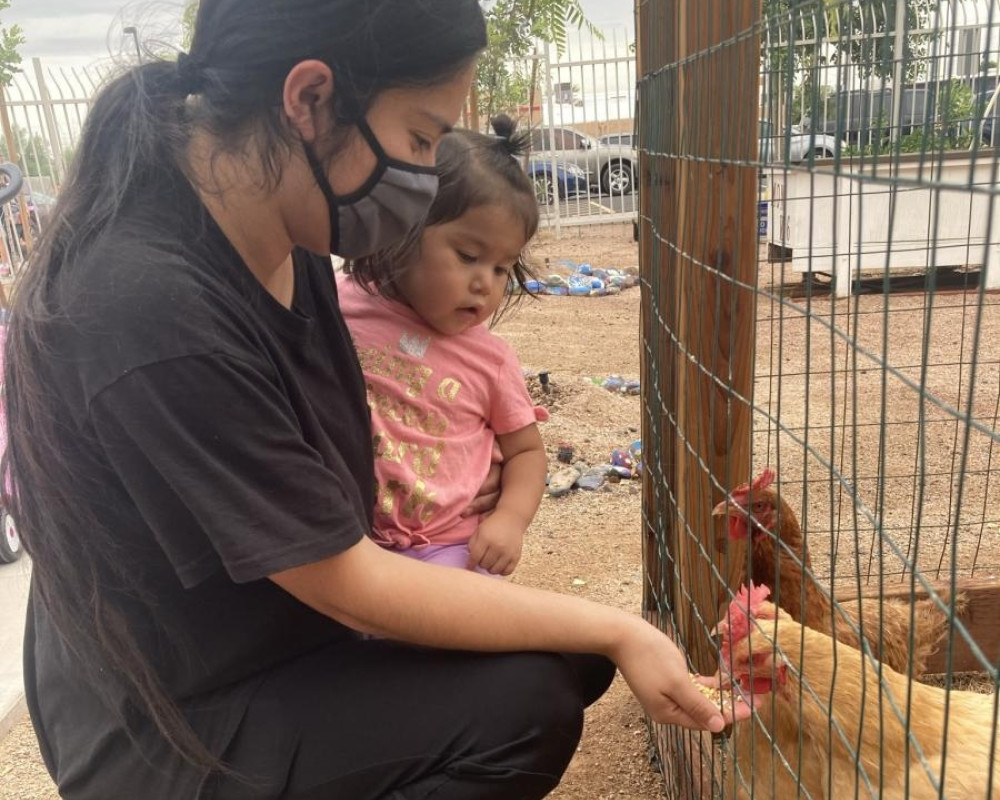
Many schoolyards are underutilized spaces and have much more to offer our children in terms of natural experiences, learning, and revitalization.
Phoenix city staff, ASU researchers, and school leaders started a green infrastructure project by planting “vegetated barriers” – otherwise known as trees and shrubs – at a childcare center and K-8 school in South Phoenix, with the purpose of reducing exposures to traffic-related air pollution and toxics and other ambient hazards (e.g., extreme heat).
This project builds on an existing initiative on children’s healthy play and learning environments at Paideia Academies in South Phoenix, as well as initiatives within the City of Phoenix, specifically the Sustainability Goals and Tree and Shade Master Plan, focusing on vegetation and shade provision where people use spaces most.
And schools play an important role in the City’s tree and shade goals. School grounds are spaces where physical activity is encouraged too. To do so safely, our goal is to minimize air pollution and extreme heat exposures, two factors often overlooked in playground safety.
The school partner – Paideia Academies – serves 840 students ages 2–14 years. 84% of the students are on the free/reduced lunch program, which is largely minority students from Hispanic/Latino (67%) and Black/African American (20%) backgrounds.
Environmental inequities from segregationist planning and zoning practices in the early 20th century placed industrial facilities in minority-dominated neighborhoods in the South Phoenix area, which led to economic, health, and quality of life challenges that are still present today.
Respiratory illness in children tracks closely with variations in local traffic patterns, which is concerning given that many playgrounds are sited near heavily trafficked roads. For example, nearly 8,000 U.S. public schools are within 500 feet of highways, truck routes, and other roads with significant traffic, and exercise can also increase breathing rates in children by 17-fold. Roadway pollutants include carbon monoxide, nitrogen dioxide (NO2), PM, and polycyclic aromatic hydrocarbon (PAH), among others, where PAHs are known neurotoxins.
The City of Phoenix partnered with Paideia Academies to promote this example in other schools and parks, and ASU is working with Phoenix’s urban forester to generate a list of plants that can act as effective vegetative barriers that also meet Phoenix’s safety criteria.
In the short term, these outdoor spaces directly support the health of children with the provision of much-needed outdoor spaces. Long-term, the project aims to reduce health disparities and support the City’s Sustainability goals to promote planting trees at Paideia and in other playspaces to help reach a 25% canopy cover across the city.
In addition to the clean air benefits provided by the new trees and naturescapes, Brian Winsor, founder of Paideia Academies, shared a poem written by one of the school's 5th-grade students. After studying Walt Witman’s “When I Heard the Learned Astronomer,” the student wrote: “When the wind flew by, I felt cold. When the sun came shining, I felt warm. When the grass went from side to side, I felt at ease. When the tree waved at me, I felt the breeze.”
Interested in learning more? Contact Dr. Jenni Vanos, Arizona State University, at Jenni.Vanos@asu.edu.
Is your City interested in being part of Healthy Babies Bright Futures’ Bright Cities program? To discuss this and anything else, please contact Bright Cities Program Director, Kyra Naumoff Shields at knaumoff@hbbf.org.
Related Content

Playbook for Children's Health

