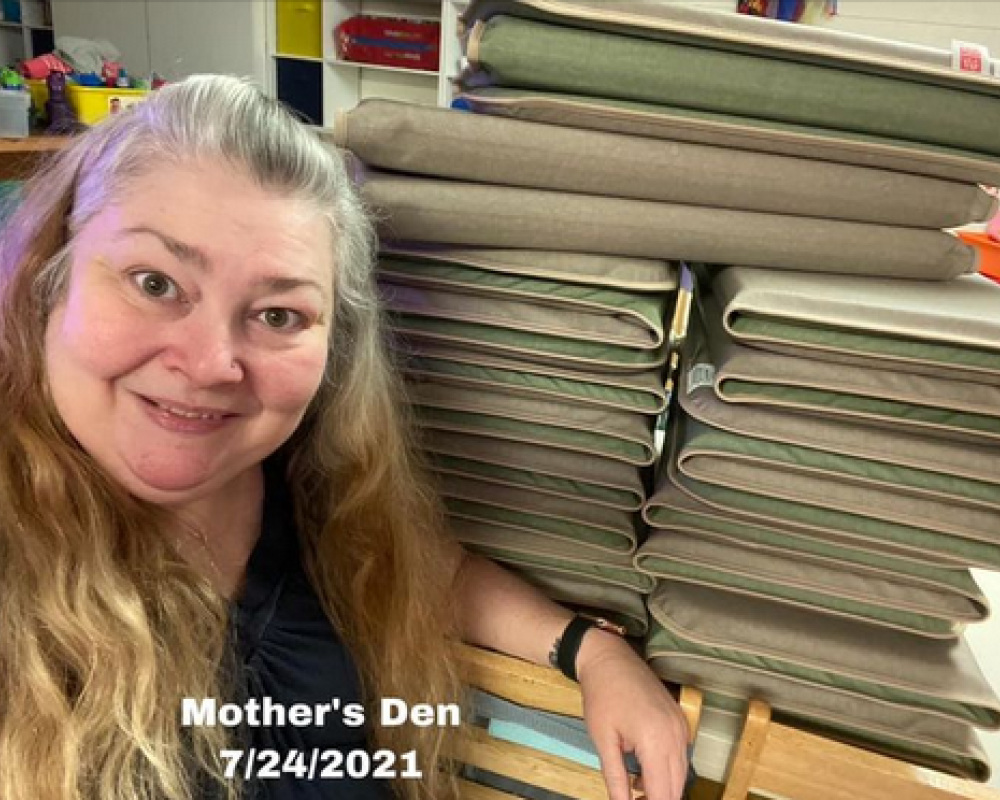
Anchorage, AK, has scaled up nap mat education and replacement to have a measurable and positive impact on health of Alaska’s babies. They’ve been a Bright City since 2018, and have steadily and significantly grown strategies to improve children’s health.
“The Anchorage Health Department operates the Child Care Licensing Program for the Municipality of Anchorage,” says Natasha Pineda, Director of the Anchorage Health Department. “We have more than 200 licensed childcare homes and centers providing care to an estimated 10,568 children. This is an opportunity to make an immediate reduction of harmful chemical exposures and improve the wellbeing of the children we care for.”
With funding from HBBF and Mayors Innovation Project, the Anchorage Mayor’s Office, Alaska Community Action on Toxics, and thread Alaska, the city replaced nearly 500 nap mats containing flame retardant chemicals with chemical-free nap maps, reducing neurotoxic exposure to hundreds of children now and for years to come.
Alaska Community Action on Toxics, in collaboration with our partners, developed a “Healthy Children in Toxic-Free Childcare” training, designed to inform providers and educators about ways to reduce childhood exposures to neurotoxic chemicals, including heavy metals, fluorinated chemicals, flame retardants, volatile organic chemicals (solvents and formaldehyde used in cleaning products and building materials), PVC plastic, phthalates, pesticides and antimicrobials. The training has been approved for continuing education credits (CECs) by the Alaska System for Early Education Development (SEED). To date, we have offered this training in both Spanish and English to more than 200 childcare providers.
Finally, our coalition is working with the city to develop an Environmentally Preferable Purchasing Policy. The policy was endorsed by the Anchorage Health Department’s Health and Human Services Commission in October 2020 and is likely to be passed in 2021 by the Anchorage Assembly. The policy requires purchase of products that are free from heavy metals, PFAS, bisphenols, orthophthalates, flame retardants, and other chemicals of concern.
Other provisions include requirements to reduce waste, increase energy conservation, and purchasing of energy from renewable sources. The policy also recommends that the Anchorage City Manager work with the Municipal League and city managers throughout the state to develop environmentally preferable purchasing programs. This will effectively increase the market power for collective and major purchasing of safer products and energy by municipalities in Alaska.
Taken together, this represents a powerful and effective set of policy and programmatic tools to reduce toxic exposure in young children in both the short and long-term.
Interested in learning more? Contact Pamela Miller, Alaska Community Action on Toxics, pamela@akaction.org or (907) 222-7714.
Is your City interested in being part of Healthy Babies Bright Futures’ Bright Cities program? To discuss this and anything else, please contact Bright Cities Program Director, Kyra Naumoff Shields at knaumoff@hbbf.org.
Related Content

Playbook for Children's Health

